-
01 Sep, 2026
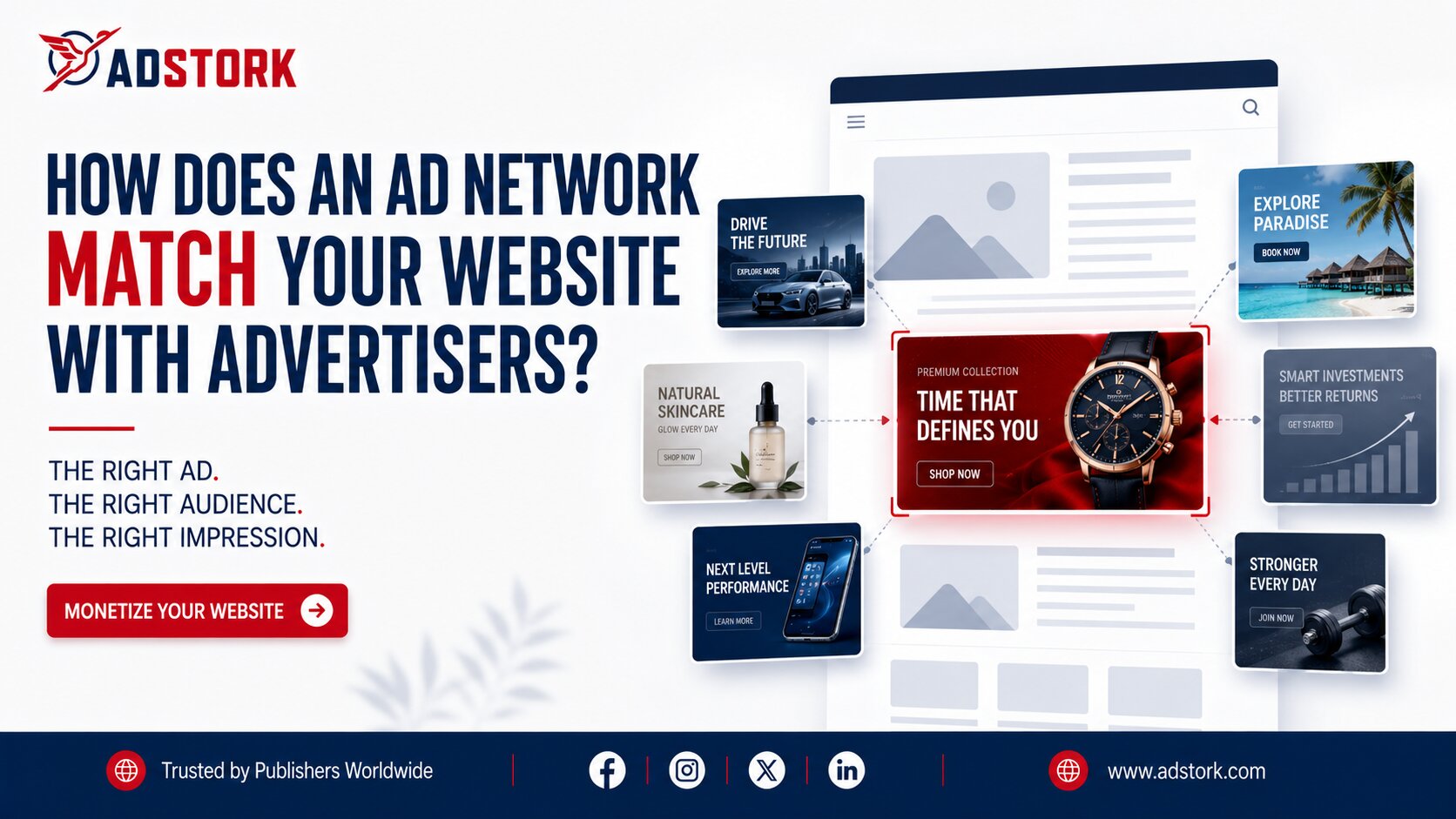
How Does an Ad Network Match Your Website With Advertisers?
When a user visits your website, something remarkable happens behind the scenes. In milliseconds, your available ad space is evaluated, bid on, and filled with a relevant advertisement—all without you lifting a finger. But how does an ad network actually decide which advertiser gets to show their ad on your site?The matching process is built on four key mechanisms: understanding your inventory, connecting to advertiser demand, running real-time auctions, and applying intelligent targeting. Let us break down exactly how it works.Key TakeawaysMatching is built on four mechanisms: understanding inventory, connecting to demand, running auctions, and intelligent targeting.Most modern networks use real-time bidding where advertisers compete for each impression in milliseconds.Header bidding runs parallel auctions where multiple demand sources compete simultaneously.Higher competition drives higher CPMs and better fill rates than traditional waterfall setups.Not every request fills—waterfall or passback chains capture revenue from secondary demand sources.1. Understanding Your InventoryThe match begins with a clear understanding of what you have to offer. When you place an ad tag on your website, you are essentially broadcasting your available inventory to the ad network.The ad tag captures essential signals about each impression. Contextual signals include page topic, keywords, content category, and IAB content labels. Geographic data shows where the user is located at the country, region, and city level. Device information identifies whether they are on desktop, mobile, tablet, or connected TV. User behaviour signals track engagement patterns, return frequency, and session depth. Publisher signals communicate site quality, audience composition, and first-party data.Ad networks also evaluate the quality signals embedded in your inventory. They look at viewability rates, traffic quality, brand safety, and the overall reputation of your site. Once the network understands what you are offering, it can begin the matching process.Neuromarketing insight: the more transparent and detailed your inventory signals, the more confidence advertisers have in your audience. Confidence triggers higher bids because advertisers subconsciously perceive lower risk. This is why publishers who provide clear contextual and audience signals consistently outperform those who do not.2. Connecting to Advertiser DemandAdvertisers come to ad networks with specific campaigns. They know who they want to reach, what budget they have, and what kind of context they want their ads to appear in.Advertisers define their campaigns using targeting parameters. Audience signals include demographics, interests, first-party data, and deterministic IDs like UID2 or RampID. Geographic targeting specifies specific countries, regions, or cities they want to reach. Contextual targeting uses keywords, topics, and content categories that align with their brand. Device targeting chooses desktop, mobile, app, or CTV. Dayparting targets specific times of day or days of the week.The ad network's role is to aggregate this demand—often connecting to multiple demand sources including direct advertisers, demand-side platforms, and programmatic exchanges—so that your inventory is exposed to as many potential buyers as possible. When the right advertiser meets the right publisher impression, a match can be made.3. The Auction: How the Match Is DecidedMost modern ad networks use a real-time bidding (RTB) auction to determine which advertiser wins each impression. This is where the matching truly happens.The auction process follows a clear sequence. Your ad request is sent to multiple demand sources simultaneously. Each advertiser evaluates the impression against their campaign goals. Advertisers submit bids based on the value they assign to the impression. The highest bid wins—provided it meets your floor price.The auction happens in milliseconds. The user never sees it. Ad networks may use different auction types including open auction (any buyer can bid on any available impression), private marketplace (invitation-only auction with approved buyers at negotiated floor prices), preferred deals (fixed price deals where an advertiser gets first look before the open auction), and programmatic guaranteed (reserved inventory at a fixed CPM, no auction involved).4. Intelligent TargetingThe matching process is powered by intelligent targeting that ensures the right ad reaches the right user. This is where algorithms do the heavy lifting.Matching algorithms evaluate multiple factors simultaneously. Supply predicates include impression characteristics like geography, device, and context. Demand predicates include ad characteristics like creative format, brand requirements, and campaign goals. Path optimisation involves finding the most efficient route from publisher to advertiser with minimal fees.Ad networks use historical performance data to improve future matches. They learn which advertisers perform best on which types of inventory, adjusting bids and targeting accordingly. Supply path optimisation (SPO) has also become critical. Instead of routing impressions through multiple intermediaries (each taking a fee), networks increasingly look for the most direct, cost-effective path from publisher to advertiser.What Happens When There Is No Match?Not every ad request results in a filled impression. If no advertiser bids or no bid meets your floor price, the request goes unfilled. To minimise this, many networks use waterfall or passback chains.The request goes to the first demand source. If it does not fill, it passes to the second, then a third, and so on. This chain approach helps capture revenue that would otherwise be lost, even if the first bidder does not want the impression.Industry Insight: The Adstork ApproachAdstork handles the matching process through a unified header bidding platform that connects your inventory to multiple premium demand sources simultaneously. Instead of a waterfall where partners are called one at a time, header bidding runs a parallel auction where all demand sources compete for every impression at the same time.This approach delivers better results. More competition means multiple buyers bid on every impression. Higher CPMs result from competition driving prices up. Better fill rates come from more buyers increasing the chances to fill. Transparent reporting lets you see exactly which demand sources are winning.The result is a matching process that maximises your revenue by exposing your inventory to the widest possible pool of advertisers—and letting the highest bidder win.The matching process determines your revenue potential. Adstork handles matching through a unified header bidding platform that connects your inventory to multiple premium demand sources simultaneously, creating real-time competition that drives higher CPMs and better fill rates. Sign up for a free Adstork publisher account and see how better matching can transform your earnings.Comparison Table: Auction TypesA quick comparison of the different auction types used in ad network matching.Auction TypeWho Can BidPricingBest ForOpen Auction (RTB)Any buyer with access to the exchangeReal-time competitive biddingMaximising yield on remnant inventoryPrivate Marketplace (PMP)Approved buyers onlyNegotiated floor prices, real-time biddingPremium inventory with trusted buyersPreferred DealSingle buyerFixed priceFirst look access before open auctionProgrammatic GuaranteedSingle buyer, reserved inventoryFixed CPMGuaranteed revenue, premium relationshipsFuture Outlook: The Evolution of Ad MatchingThe matching process is evolving rapidly. Several trends will shape how ad networks connect publishers with advertisers.AI-powered matching is becoming more sophisticated. Machine learning models analyse thousands of signals in milliseconds, predicting which advertisers will perform best on which inventory and adjusting bids in real time.First-party data integration is becoming essential. As third-party cookies disappear, matching relies more on publisher-provided audience signals. Publishers with strong first-party data will see better matches and higher CPMs.Header bidding is becoming the default. Networks that do not support parallel auctions will be left behind. More competition means better matches and higher revenue.Supply path optimisation is becoming standard. Networks are reducing intermediaries to create more direct, efficient paths from publisher to advertiser—capturing more value for both sides.The matching process between publishers and advertisers is a sophisticated ecosystem of signals, auctions, and algorithms. Ad networks understand your inventory, connect to advertiser demand, run real-time auctions, and apply intelligent targeting to find the best match for every impression.The better the match, the higher the revenue. Header bidding creates more competition by letting multiple demand sources bid simultaneously, driving higher CPMs and better fill rates. Adstork handles the entire matching process through a unified platform, connecting your inventory to premium demand sources and delivering transparent results. Sign up for a free Adstork publisher account and see how better matching can transform your earnings.Your immediate action plan: Review your current ad network's matching approach. Do they use header bidding or waterfall? Can you see which demand sources are winning your impressions? If you are not seeing competition-driven pricing, consider testing a network that does. Adstork's transparent reporting shows you exactly how your inventory is being matched—and what you are earning from each demand source.FAQsHow does an ad network match my website with advertisers? Ad networks match your website with advertisers through four mechanisms: understanding your inventory (contextual signals, geography, device, audience), connecting to advertiser demand (campaign goals and targeting parameters), running real-time auctions (where multiple advertisers bid on each impression), and applying intelligent targeting (algorithms that evaluate supply and demand signals to find the best match).What is real-time bidding? Real-time bidding (RTB) is the process where advertisers bid on each impression in milliseconds. When a user visits your site, an auction occurs, and the highest bidder's ad is delivered. RTB ensures you capture the true market value of your inventory.What is the difference between header bidding and waterfall? Header bidding sends your ad request to multiple demand sources simultaneously, creating a parallel auction where all bidders compete at the same time. Waterfall sends requests to demand sources one at a time in a fixed order. Header bidding typically generates higher CPMs because more competition drives prices up.What happens when no advertiser bids on my inventory? If no advertiser bids (or no bid meets your floor price), the request goes unfilled. Many networks use waterfall or passback chains to capture revenue from secondary demand sources. The request passes to the next demand source in line, and so on, until a bid is received.What is supply path optimisation? Supply path optimisation (SPO) is the practice of finding the most direct, cost-effective route from publisher to advertiser. Instead of routing impressions through multiple intermediaries (each taking a fee), SPO reduces the number of hops to capture more value for both publishers and advertisers.How does Adstork handle matching differently? Adstork uses header bidding to run parallel auctions where multiple demand sources compete for every impression simultaneously. This creates more competition, driving higher CPMs and better fill rates. Transparent reporting shows you exactly which demand sources are winning your impressions.
Read More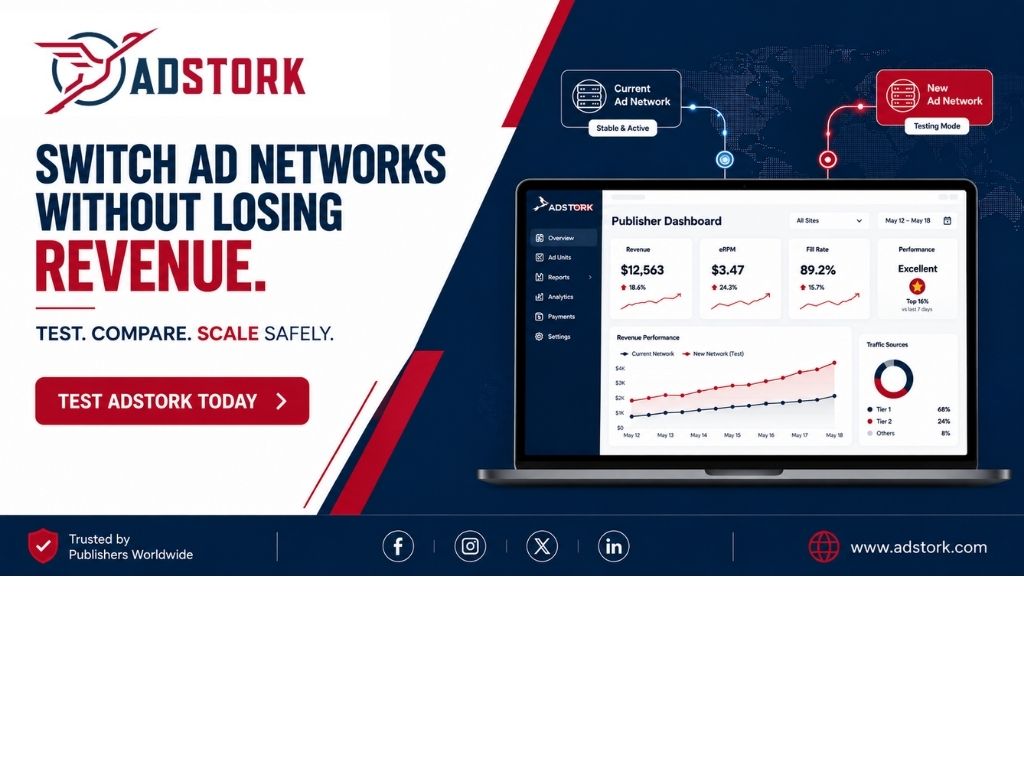
-
31 Aug, 2026
Switching Ad Networks Without Disrupting Your Website: What Publishers Should Know
Your current ad network is not performing the way it used to. Fill rates are slipping. CPMs are flat. Support is slow. You are considering a switch.But switching ad networks is not like switching email providers. If you do it wrong, your revenue can plummet overnight. Users might see blank ad slots. Your analytics will become a mess. And you will have no way to know if the new network is actually better or if you just made a costly mistake.This guide walks you through exactly how to evaluate, test, and switch ad networks without disrupting your website. It covers why publishers switch, what to compare first, how to test new networks safely, and when to scale up—with practical steps at every stage.Key TakeawaysNever switch entirely without testing first—a "split test" approach protects your revenue.Compare 12 factors before testing: approval speed, formats, demand quality, reporting, payment terms, and support.Run parallel tests with new networks on low-traffic placements while maintaining your existing setup.Compare effective RPM, fill rate, viewability, and user experience, not headline CPM.Scale only when the new network consistently outperforms your current setup for at least 2-4 weeks.Adstork is designed for easy testing—add it as an additional demand source without disrupting existing monetization.Why Publishers Switch Ad NetworksPublishers switch ad networks for many reasons. Understanding why you are considering a switch helps clarify what you are looking for.Declining performance. Fill rates dropping below 70%. CPMs sliding month over month. Revenue flat or falling despite traffic growth. These are signs that your network's demand sources are weakening.Poor support. Slow responses to issues that cost you revenue. No optimisation advice. No dedicated account manager. When something breaks, you are left waiting.Limited formats. Your network does not support video, native, or other formats that could improve your revenue. You are leaving money on the table.Reporting gaps. You cannot see fill rate by country, CPM by format, or revenue per session. You are optimising in the dark.Traffic growth restrictions. Your network has traffic requirements that exclude you, or they are not supporting your growth stage.Payment issues. High minimum payouts, slow payment cycles, or limited payment methods create friction.Geographic gaps. Your network does not cover your key geos well. Fill rates are poor in tier-2 and tier-3 countries where much of your traffic comes from.Neuromarketing insight: the frustration of a declining relationship creates a psychological bias toward action—"anything is better than this." But this urgency can lead to rushed, poorly evaluated decisions. Resist the urge to switch immediately. Take a systematic approach to evaluation.Step 1: What to Compare FirstBefore you test any new network, evaluate it against the 12-point checklist from our previous guide. But when you are considering a switch, three factors matter most for comparison.Demand quality. What demand sources does the network connect to? Are they premium SSPs and direct advertisers, or lower-tier exchanges? Premium demand means higher CPMs and better fill.GEO coverage. Does the network cover your key geos? If your traffic is primarily tier-2, a network focused on tier-1 will have weak fill. Match the network's strengths to your traffic profile.Reporting transparency. Can you see fill rate, CPM, and revenue segmented by country, device, format, and placement? Transparent reporting is essential for comparing performance.Do not compare headline CPMs. One network might promise $10 CPM but have 40% fill. Another might offer $4 CPM with 90% fill. The second network is better.Step 2: Keep Existing Monetization During TestingThis is the most important rule of switching ad networks: never remove your current setup before testing the new one.When you remove your current network, you lose all revenue from it. If the new network underperforms, you will have no fallback. Your revenue will drop, and you will have to re-integrate the old network—a painful process.Instead, use a parallel testing approach. Keep your current network running on most of your inventory. Test the new network on a limited subset. This protects your revenue while you evaluate performance.Practical approaches:• Run new network on specific placements (e.g., only sidebar or only in-content).• Use header bidding to add the new network as an additional demand source.• Test on specific geos where your current network is weak.• Run a small percentage of traffic through the new network.This approach gives you a direct comparison without risking your primary revenue.Step 3: Testing New Placements and FormatsIf you are switching because your current network lacks certain formats, use the testing period to evaluate how the new formats perform.Start with one new format on one placement. For example, if you currently run only display ads, test the new network's native units in your content feed. Run it for at least two weeks to gather sufficient data.Evaluate the new placement against your existing ones. Does it generate higher effective RPM? Does it improve fill rate? Does it affect user experience metrics like bounce rate or session duration?Do not rush to add all new formats at once. Test one at a time. Measure performance. Scale what works. Reject what does not.Step 4: Comparing Revenue the Right WayHeadline CPM is a vanity metric. It tells you what an advertiser agreed to pay, not what you actually earned. When comparing networks, use effective RPM and revenue per session.Effective RPM = CPM × Fill RateIf Network A has $10 CPM and 30% fill, effective RPM is $3. Network B has $4 CPM and 90% fill, effective RPM is $3.60. Network B is better.But go even deeper. Compare revenue per session—what you earn from each visitor. If a high-CPM network has intrusive ads that drive users away, your revenue per session will drop. The network that balances revenue with user experience will win over time.Also compare by segment. Network A might outperform on US desktop traffic but underperform on mobile tier-2. The right network depends on your specific traffic mix.Step 5: Monitoring Fill Rate and User ExperienceTwo factors that often get overlooked during network switching: fill rate and user experience. Both can make or break your revenue.Fill rate is the percentage of ad requests that successfully display an ad. A network with high CPM but low fill might generate less revenue. Monitor fill rate by country, device, and format during testing.User experience is harder to measure but equally important. Monitor bounce rate, session duration, and pages per visit during testing. If a new network drives users away, the short-term revenue gains will cost you long-term.Also monitor ad quality. Are the new network's ads clean and relevant, or do they include low-quality creative that damages your brand? User complaints about ad quality are a red flag.Run the test for at least two to four weeks. This gives you enough data to account for daily and weekly fluctuations. Longer is better—seasonality and advertiser budget cycles can affect performance.Step 6: When to Scale (and When to Walk Away)Once you have two to four weeks of data, you can decide whether to scale the new network or walk away.Scale when:• The new network consistently outperforms your current setup on effective RPM.• Fill rate is equal or better across your key geos.• User experience metrics (bounce rate, session duration) are stable or improved.• Support and reporting meet your expectations.• The performance gap is significant enough to justify the switch.Walk away when:• The new network underperforms on effective RPM.• Fill rate is significantly lower.• User experience metrics decline.• Support is unresponsive or unhelpful.• The performance gap is small or inconsistent.If you decide to scale, move gradually. Start with 20-30% of your inventory. Monitor performance closely for another week. Then increase to 50%, then 75%, then 100% over a few weeks. This approach catches issues early and minimises risk.If the new network only outperforms on certain geos, formats, or devices, consider using both networks side by side. Many successful publishers use multiple networks in a header bidding setup.Testing new networks should be simple and low-risk. Adstork is designed for easy integration alongside your existing setup—add it as an additional demand source without disrupting your current monetization. Run a parallel test, compare performance in transparent reporting, and scale only when you see results. Sign up for a free Adstork trial and test additional demand without risking your existing revenue.Industry Insight: What Successful Switchers DoAnalysis of publishers who successfully switched ad networks reveals common patterns.Successful switchers run parallel tests for 2-4 weeks before making any changes. They compare effective RPM, not headline CPM. They monitor user experience metrics alongside revenue. They scale gradually, not all at once.Unsuccessful switchers remove their current network immediately, losing revenue if the new network underperforms. They compare only CPM, missing fill rate and user experience. They switch entirely without testing, creating unnecessary risk.The data also shows that publishers who add networks rather than replace them often see the best results. Header bidding with multiple demand sources increases competition and drives higher CPMs. The "switch" is often better framed as "add and optimise."One publisher switched from a single-SSP setup to header bidding with three SSPs, including Adstork. They saw a 35% revenue lift within 30 days—not because any single network was dramatically better, but because competition drove higher bids across all partners.Comparison Table: How to Compare Networks Before SwitchingA quick reference guide for comparing your current network against potential alternatives.FactorCurrent NetworkNew Network (Candidate)DifferenceEffective RPM$3.50$4.20+20%Fill Rate75%85%+10%Revenue Per Session$0.12$0.15+25%GEO CoverageWeak in tier-2Strong globallyBetterReportingBasicGranular, transparentBetterSupportSlowResponsive, dedicatedBetterUser Experience ImpactIntrusive adsBalanced, cleanBetterFuture Outlook: The Network Landscape in 2026 and BeyondThe ad network landscape is changing. Understanding future trends helps you choose a network that will grow with you.First-party data integration is becoming essential. Networks that help you collect and activate first-party data will be more valuable. Choose a network that supports audience segmentation and data sharing.Header bidding is becoming the default. Networks that do not support header bidding will be left behind. Multi-SSP competition drives higher CPMs.AI-powered optimisation is becoming available. Networks that provide automated optimisation recommendations will help you maximize revenue.Transparency requirements are increasing. Publishers are demanding more visibility into demand sources, fees, and auction dynamics. Choose a network that provides transparent reporting.When evaluating new networks, look for partners that are investing in these capabilities. The network that helps you prepare for the future will be a better long-term partner.Switching ad networks is a major decision. Done wrong, it can disrupt your revenue, confuse your analytics, and frustrate your users. Done right, it can unlock significantly higher earnings and a better partnership.The key is a systematic, data-driven approach. Compare networks on 12 factors. Run parallel tests. Compare effective RPM and revenue per session, not headline CPM. Monitor user experience. Scale gradually. Walk away if performance does not meet expectations.Adstork makes it easy to test additional demand without disrupting your current setup. Add us as a new demand source, run a parallel test, and see the results in transparent reporting. Sign up for a free Adstork publisher account and start testing additional demand today.Your immediate action plan: Identify why you are considering a switch. What is your current network missing? Use the 12-point checklist to evaluate alternatives. Start a parallel test with one new network on a limited placement. Run for 2-4 weeks. Compare effective RPM, fill rate, and user experience. Make a data-driven decision.Frequently Asked QuestionsHow do I switch ad networks without losing revenue? Never remove your current network before testing the new one. Run a parallel test on a limited subset of your inventory while keeping your current network active. Compare performance for 2-4 weeks before making any changes.How long should I test a new ad network before switching? Test for at least 2-4 weeks. This gives you enough data to account for daily and weekly fluctuations. Longer is better—seasonality and advertiser budget cycles can affect performance.What metrics should I compare when switching ad networks? Compare effective RPM (CPM × Fill Rate), revenue per session, fill rate by GEO and device, and user experience metrics like bounce rate and session duration. Do not compare headline CPM alone.Should I switch entirely or add a second network? Many successful publishers use multiple networks in a header bidding setup rather than switching entirely. Adding demand sources increases competition and can improve overall revenue. Only switch entirely if the new network clearly outperforms your current one in every relevant segment.What are the risks of switching ad networks? Revenue disruption if the new network underperforms, blank ad slots during migration, analytics confusion, user experience degradation from poor ad quality, and time lost managing the transition. Parallel testing mitigates these risks.How do I know if a new network is really better? Compare performance across multiple metrics over 2-4 weeks. Look for consistent outperformance in effective RPM, fill rate, and revenue per session. Ensure user experience metrics are stable or improved. Only scale when the data is clear and consistent.
Read More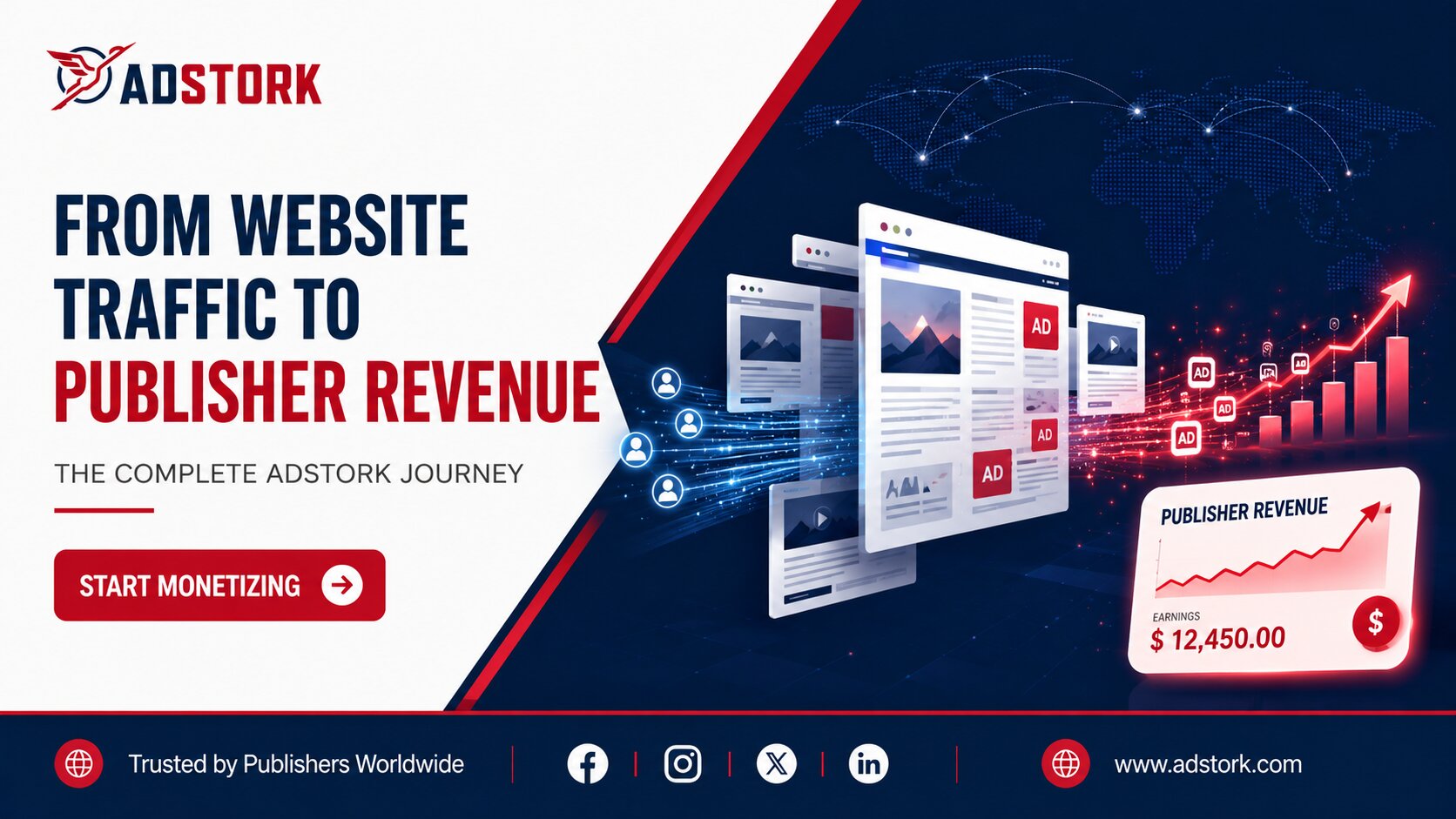
-
31 Aug, 2026
From Website Traffic to Publisher Revenue: The Complete Adstork Journey
You built a website. You created content. You attracted an audience. Now you want to turn that traffic into revenue.But how does it actually work? What happens between a user visiting your site and you receiving a payment?The Adstork publisher journey is a complete ecosystem designed to turn your existing traffic into consistent, growing revenue. It is not just about showing ads, it is about connecting your audience with the right advertisers, measuring performance in real time, and giving you the tools to optimise and scale.This guide walks you through every step of the journey, from building your audience to receiving your payout. Whether you are a new publisher or an established site looking to grow, this is your roadmap to sustainable monetisation.Key TakeawaysThe Adstork publisher journey follows 9 clear steps from audience building to payout.Instant approval means you can start monetising your traffic the same day you sign up.Adstork connects your inventory to 5B+ daily impressions across 195+ regions.Real-time performance measurement and transparent reporting give you full visibility.AI-driven optimisation tools help you maximise revenue without manual guesswork.Weekly payments with a low $50 minimum threshold get you paid faster.The 9-Step Adstork Publisher JourneyThe journey from website traffic to publisher revenue follows a clear, logical path. Each step builds on the last, creating a complete monetisation ecosystem.① Build Your AudienceEvery monetisation journey starts with an audience. Your website, app, or content platform attracts visitors who engage with your content. This is the foundation of everything that follows.Advertisers do not buy traffic, they buy audiences. The quality of your audience their engagement, geographic location, demographics, and intent determines the value of your inventory. A smaller, highly engaged audience can be worth more than a larger, passive one.At this stage, focus on building genuine audience relationships through quality content, community engagement, and consistent value delivery. The stronger your audience foundation, the more effective every subsequent step will be.Neuromarketing insight: trust is the currency of the attention economy. When you build genuine audience relationships, you create a subconscious signal of quality that advertisers recognise and reward with higher bids.② Join AdstorkOnce you have an audience, the next step is joining Adstork. The sign-up process is simple and fast, create your publisher account, submit your website or app for review, and get approved.Unlike many networks that take days to approve publishers, Adstork offers instant approval. There are no minimum traffic requirements, publishers of all sizes are welcome. You can start monetising your traffic the same day you sign up.Adstork evaluates traffic quality, not just volume. A publisher with 500,000 quality impressions can be more valuable than one with 10 million questionable impressions. Quality gets partnerships.③ Add Advertising InventoryOnce approved, you access Adstork's full suite of ad formats and inventory options. Your dashboard displays the ad units best suited to your traffic, content, and audience.Available formats include display banners, native ads, popunders, push notifications, in-page push, and video. You are not locked into one format, you can choose the mix that works best for your site and test different combinations.Push ads are particularly valuable for publishers seeking to diversify their monetisation strategies. They are simple to implement, require no significant changes to your existing setup, and provide consistent monetisation by delivering highly relevant ads regardless of the user's browsing status.Integration is straightforward, copy and paste code snippets, or use pre-built plugins for platforms like WordPress. No developer required.④ Connect With DemandThis is where Adstork's ecosystem comes to life. Your inventory is connected to multiple premium demand sources through a unified platform.Adstork operates with over 5 billion daily ad impressions across 195+ regions globally. Demand sources include leading SSPs, direct advertisers, and specialised networks. This scale ensures your inventory reaches the right buyers, regardless of your geographic mix.The platform uses sophisticated data analytics to connect the right advertisers with the right audiences. Every decision is backed by data, ensuring tangible results. Advanced anti-fraud algorithms protect ad safety and brand reputation.This demand connection is built on header bidding technology, creating real-time competition for every impression. More competition means higher CPMs and better fill rates.⑤ Ads Are Matched and DeliveredWhen a user visits your site, the real-time auction begins. Adstork's platform sends your inventory to multiple demand sources simultaneously. Bidders evaluate the impression, and the highest bid wins.The matching process considers audience signals, geographic location, device type, user behaviour, and contextual relevance. This ensures ads are relevant to your audience, improving performance and user experience.The entire auction happens in milliseconds, users see a relevant ad without any noticeable delay. The ad is delivered seamlessly, earning you revenue from that impression.This is where your traffic becomes revenue. Every filled impression, every click, every conversion contributes to your earnings.⑥ Performance Is MeasuredTransparency is a core principle of the Adstork ecosystem. Every impression, click, and conversion is tracked and reported in real time.The analytics dashboard provides granular data segmented by country, device, format, and placement. You can see fill rate, CPM, eCPM, revenue per session, and other key metrics. Reports are available in real time or daily summaries.This visibility is essential for optimisation. Without knowing what is working and what is not, you are guessing. With transparent reporting, you can make data-driven decisions that increase your revenue.⑦ Review EarningsYour earnings dashboard shows your revenue in real time. You can see which formats, geos, and placements are generating the most revenue, and which are underperforming.This is where you assess performance against your goals. If you are seeing strong earnings in US desktop traffic but weak performance in mobile tier-2, that insight tells you where to focus optimisation efforts.Adstork provides clear, detailed reports with fair pricing and open communication. No hidden fees. No surprises. You always know where you stand.⑧ OptimizeOptimisation is where the real revenue growth happens. With performance data in hand, you can make targeted adjustments to improve your earnings.Adstork provides advanced optimisation tools including CPA Goal, automated rules, and creative templates. These AI-driven tools help you maximise revenue without manual guesswork. The platform's AI-driven decision-making focuses on consistency, transparency, and long-term value.You can also make manual adjustments based on your data, testing different floor prices, adding new demand partners, or optimising ad placement for better viewability. The goal is continuous improvement toward higher effective RPM and revenue per session.With over 7 years of industry expertise and a dedicated team of account managers, developers, and support staff, Adstork provides the guidance you need to optimise effectively.⑨ Receive PayoutThe final step—receiving your earnings. Adstork offers flexible payment options including bank transfer, PayPal, wire, Bitcoin, and Payoneer.The minimum payout threshold is competitive, typically $50. This means even smaller publishers can access their earnings regularly without waiting months to reach a high threshold.Payments are processed weekly on request. You get paid faster, with consistent, reliable payment cycles.This is the culmination of the journey, your traffic, audience, and content have been transformed into sustainable, growing revenue. And because the ecosystem is designed for continuous improvement, the journey does not stop here. You optimise, grow, and earn more over time.The complete Adstork publisher journey is designed for one outcome: turning your existing traffic into consistent, growing revenue. Sign up for a free Adstork publisher account and start your journey today.Industry Insight: The Adstork DifferenceThe Adstork journey is not just about ad tags and payments. It is a complete ecosystem designed for sustainable publisher growth.AI-driven decision-making powers the platform. The 2026 strategy focuses on consistency, transparency, and long-term value for buyers and publishers. Every decision is backed by data.Dedicated support sets Adstork apart. With a team of 15+ account managers, 12+ developers, and 7+ back-office staff operating 24/7, you are never alone. Dedicated account managers with 3+ years of expertise provide personalised support and optimisation guidance.Transparency is built into every step. Clear and detailed reports, fair pricing, and open communication ensure you are always informed and confident in the value you receive.Global reach with over 5 billion daily ad impressions across 195+ regions ensures your inventory reaches the right buyers.The Adstork ecosystem is designed to foster collaboration between advertisers and publishers, providing a space for open communication, shared goals, and mutual support.Comparison Table: The Adstork Journey vs. Typical Ad NetworksHow the Adstork publisher journey compares to typical ad networks across key stages.StepAdstorkTypical Ad NetworkApproval TimeInstantDays to weeksTraffic RequirementsNone (quality-focused)High minimum thresholdsAd FormatsMultiple (display, native, push, popunder, video)Limited selectionGlobal Reach5B+ impressions, 195+ regionsLimited coverageReportingTransparent, granular, real-timeBasic, delayedOptimisation ToolsAI-driven (CPA Goal, automated rules)Manual onlySupport24/7 dedicated account managementLimited, slowMinimum Payout$50$100-$500Payment FrequencyWeekly (on request)MonthlyFuture Outlook: The 2026 Adstork EcosystemThe Adstork ecosystem is evolving to meet the changing needs of publishers in 2026 and beyond.AI-driven decision-making is at the core of the 2026 strategy. The platform is refining how campaigns run across the ad network and exchange, focusing on consistency, transparency, and long-term value.First-party data integration is becoming essential. Adstork is building tools to help publishers collect, organise, and monetise first-party audience data.Advanced fraud prevention protects publisher and advertiser value. Cutting-edge anti-fraud algorithms ensure ad safety, protect brand reputation, and deliver high-quality traffic.Sustainable growth is the long-term focus. Adstork is designed to help publishers build consistent, growing revenue—not just short-term gains.Publishers who join Adstork are not just getting an ad network. They are joining an ecosystem designed for their long-term success.The journey from website traffic to publisher revenue follows a clear path. Build your audience. Join Adstork. Add your inventory. Connect with demand. Watch ads match and deliver. Measure performance. Review earnings. Optimise. Receive payout.Each step builds on the last, creating a complete monetisation ecosystem designed to turn your existing traffic into consistent, growing revenue. The Adstork difference is transparency, AI-driven optimisation, dedicated support, and a focus on long-term publisher success.Ready to start your journey? Sign up for a free Adstork publisher account and begin monetising your traffic today.Frequently Asked QuestionsHow long does it take to get approved as an Adstork publisher? Adstork offers instant approval for most publishers. You can sign up and start monetising your traffic the same day.What traffic volume do I need to join Adstork? There are no minimum traffic requirements. Adstork evaluates traffic quality, not just volume. Publishers of all sizes are welcome.What ad formats does Adstork support? Adstork supports multiple formats including display banners, native ads, push notifications, in-page push, popunders, and video.How does Adstork's global reach benefit publishers? With over 5 billion daily ad impressions across 195+ regions, Adstork connects your inventory to demand sources worldwide. This ensures better fill rates and higher CPMs, regardless of your geographic traffic mix.What is the minimum payout threshold? Adstork's minimum payout is typically $50, making it accessible for publishers of all sizes.How often does Adstork pay publishers? Payments are processed weekly on request. You get paid faster with consistent, reliable payment cycles.
Read More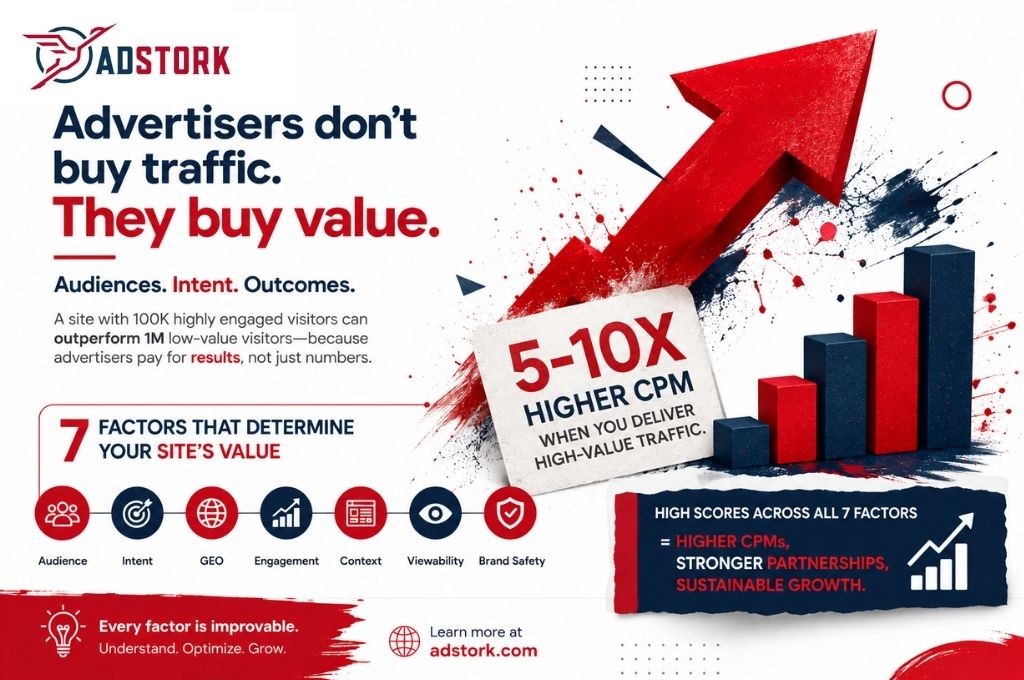
-
27 Aug, 2026
What Makes a Website Valuable to Advertisers? 7 Key Factors
Most publishers believe that more traffic is the answer to everything. More visitors means more ad revenue, right?Not exactly.Advertisers do not buy traffic. They buy audiences. They buy outcomes. They buy the likelihood that a person will see their message, engage with their brand, and take action.A website with 100,000 highly engaged, high-value visitors can be worth more to advertisers than a site with 1,000,000 passive, low-value visitors. The difference is not in the traffic count. It is in the value advertisers assign to that traffic.Understanding what makes your website valuable to advertisers is the key to unlocking higher CPMs, stronger partnerships, and sustainable revenue growth. This guide breaks down the seven factors that determine your site's value—and how to maximize each one.Key TakeawaysAdvertisers don't buy traffic—they buy audiences, intent, engagement, and outcomes.A site with 100,000 high-value visitors can earn more than one with 1,000,000 low-value visitors.Seven factors determine advertiser value: audience, intent, geography, engagement, context, viewability, and brand safety.High scores across all seven factors command CPMs 5-10x higher than poor scores.Every factor is improvable—understanding them is the first step to increasing your site's value.1. Audience: Who Is Visiting Your Site?Audience is the foundation of advertiser value. Advertisers want to know who they are reaching—demographics, purchasing power, lifestyle, and loyalty.A high-value audience has strong demographics—affluent, educated, decision-makers. They are loyal—returning regularly, engaging deeply with content. They have purchasing power—they buy products and services. They trust your brand—they see you as an authority.A low-value audience has weak demographics—low income, limited education. They are passive—bouncing quickly, engaging superficially. They have limited purchasing power. They lack trust in your brand.Advertisers can see these differences. They use sophisticated tools to analyse audience composition. They bid accordingly.Neuromarketing insight: trust is a subconscious heuristic. When advertisers perceive your audience as high-value, they bid higher automatically. This happens before any logical analysis of the inventory. Build audience trust through quality content and transparent relationships.How to improve: Build genuine audience relationships through quality content, community engagement, and email capture. Segment your audience and understand who they are. Focus on attracting high-value demographics through targeted content and acquisition strategies.2. Intent: What Are Your Visitors Looking For?Intent is the second most important factor. Advertisers pay premium rates for audiences with commercial intent—people who are actively researching, comparing, and buying.High-intent audiences search for product reviews, compare features, read buying guides, and look for recommendations. They are in the market for something. They are ready to act.Low-intent audiences are browsing passively. They are not actively seeking products. They are not in the market. They are consuming content for entertainment, not research.The difference is visible in search queries. Someone searching "best laptop under $1000" is high-intent. Someone searching "funny cat videos" is low-intent.How to improve: Create content that targets commercial keywords. Write buying guides, product reviews, comparison articles, and "best of" content. This attracts visitors who are actively in the market and commands premium CPMs.3. GEO: Where Are Your Visitors Located?Geography is the largest structural factor in advertiser value. Demand and pricing vary dramatically by country.Tier-1 countries—United States, United Kingdom, Canada, Australia, Western Europe—command the highest CPMs. Advertiser budgets are largest, competition is fiercest, and audience purchasing power is strongest.Tier-2 countries—Eastern Europe, Latin America, parts of Asia—have lower demand and lower CPMs. Tier-3 countries—Africa, South Asia, parts of Southeast Asia—have the lowest demand and CPMs.The difference is dramatic. US traffic might earn $5-10 CPM. Indian traffic might earn $0.50-1.50. The volume might be similar. The revenue is not.How to improve: Accept that geography sets a ceiling on your CPMs. Focus on growing traffic from high-value geos. Create content that appeals to US, UK, and other premium markets. Consider localised content strategies for different regions.4. Engagement: How Do Visitors Interact With Your Site?Engagement signals how deeply visitors connect with your content. Advertisers pay more for audiences that are truly engaged.High engagement means longer session durations—visitors staying 3+ minutes. More pages per visit—exploring 3-5 pages. Lower bounce rates—below 50%. Return visits—coming back regularly. Social sharing—content that resonates.Low engagement means short sessions—under 60 seconds. Few pages per visit—1-2 pages. High bounce rates—above 80%. No return visits. No social sharing.Engagement signals are visible to advertisers through analytics and behavioural data. High engagement means more attention, more trust, and more likelihood of conversion.How to improve: Create compelling, valuable content that keeps visitors reading. Improve site speed and mobile experience. Add internal links to encourage exploration. Build community through comments and social channels.5. Context: Does Your Content Align With Advertisers' Products?Contextual relevance is increasingly important to advertisers. They want their ads to appear next to content that aligns with their brand and products.A finance brand wants to appear on finance sites. A travel brand wants to appear on travel sites. A fitness brand wants to appear on health and wellness sites. Contextual alignment improves ad performance and brand perception.Context also affects brand safety. Advertisers avoid appearing next to controversial, low-quality, or irrelevant content. The more specific and aligned your content, the more valuable your inventory.Neuromarketing insight: humans process information contextually. An ad for running shoes on a fitness site feels natural and relevant. The same ad on a politics site feels out of place and jarring. Relevance reduces cognitive resistance and increases ad effectiveness.How to improve: Build a clear niche and content strategy. Specialise in a specific topic or industry. Use content categories and tags to signal your content type to advertisers. Consider partnerships with brands that align with your audience.6. Viewability: Are Your Ads Actually Being Seen?Viewability is the percentage of ad impressions that are actually seen by users. It is one of the strongest signals of inventory quality.The industry standard for viewability is 50% of pixels visible for at least one second (display) or two seconds (video). Inventory that meets these standards commands premium CPMs. Inventory that does not is discounted or filtered.Publishers with viewability above 70% see stronger bids. Those above 80% see premium treatment. Below 50%, advertisers often reduce bids or filter entirely.Viewability also affects demand competition. More bidders compete for viewable inventory, driving CPMs higher. Less viewable inventory faces limited competition and lower bids.How to improve: Optimise ad placement to maximise viewability. Move ads above the fold. Ensure they load quickly. Avoid placing ads at the bottom of long articles where users rarely scroll. Test different placements and measure viewability.7. Brand Safety: Is Your Site a Safe Environment for Advertisers?Brand safety is increasingly important to advertisers. They want their ads to appear in safe, reputable environments. Unsafe or questionable inventory is discounted or avoided.What signals brand safety concerns? Controversial or sensitive content like politics, violence, or adult content. User-generated content with minimal moderation. Low-quality or spammy content. Piracy or copyright infringement. Misinformation or factually questionable content.Many advertisers use brand safety filters that exclude inventory flagged as unsafe. Other advertisers simply bid less on inventory they perceive as risky.The CPM impact of brand safety concerns can be dramatic. A brand-safe site might earn $8 CPM. A questionable site might earn $2-3 CPM. The traffic volume might be similar. The revenue is not.How to improve: Ensure your content is brand-safe and clearly categorised. Use content classification tools to signal your content type to advertisers. Avoid controversial or low-quality content that might trigger filters. Moderate user-generated content to maintain quality standards.Understanding your site's value to advertisers is the first step to increasing it. Adstork provides transparent reporting that shows you exactly how advertisers perceive your inventory—audience quality, engagement, viewability, and more. You can see where you score well and where you need improvement. Explore Adstork's publisher analytics and start optimising your site's advertiser value today.Industry Insight: The Value Gap in NumbersThe gap between high-value and low-value publisher inventory is substantial. Analysis across the Adstork network reveals clear patterns.Publishers with strong scores across all seven factors command CPMs 5-10x higher than those with weak scores. The difference is visible in fill rates, advertiser demand, and total revenue.A high-value publisher with engaged US audiences, commercial intent, strong viewability, and brand-safe content might earn $12-20 CPM. A low-value publisher with passive tier-3 traffic, low engagement, and questionable content might earn $1-2 CPM.The gap is not theoretical. It is visible in real revenue numbers. Publishers who understand and optimise these factors consistently outperform those who focus only on traffic volume.Comparison Table: High-Value vs. Low-Value Publisher InventoryA side-by-side comparison of high-value and low-value publisher inventory across the seven factors.FactorHigh-Value PublisherLow-Value PublisherAudienceAffluent, loyal, decision-makersLow income, passive, disengagedIntentCommercial, research, buyingEntertainment, passive browsingGEOUS, UK, Canada, AustraliaIndia, Southeast Asia, AfricaEngagement3+ min sessions, low bounce, return visitsUnder 1 min sessions, high bounce, one-timeContextClear niche, relevant to advertisersGeneral, unfocused, irrelevantViewability70%+Below 50%Brand SafetyClean, reputable, trustworthyQuestionable, risky, low-qualityTypical CPM$12 – $20$1 – $2Future Outlook: What Advertisers Will Value in 2026 and BeyondThe factors that determine advertiser value are evolving. Several trends are reshaping what advertisers want from publisher inventory.First-party data is becoming essential. As third-party cookies disappear, publishers who collect and activate first-party audience data will command premium CPMs. Advertisers increasingly value publishers who have direct, consensual relationships with their audiences.Attention metrics are emerging as a key signal. Advertisers are moving beyond viewability to measure attention and engagement. Publishers who can demonstrate genuine attention will command premium CPMs.Contextual relevance is becoming more important. With cookie deprecation, advertisers are returning to contextual targeting. Publishers with clear, relevant content will benefit.Brand safety requirements are becoming stricter. Advertisers are demanding more transparency and control. Publishers who cannot demonstrate brand safety will see reduced demand.The publishers who succeed will be those who understand and optimise all seven factors. Traffic volume alone is no longer enough.Advertisers don't buy traffic. They buy audiences, intent, engagement, and outcomes. Understanding what makes your website valuable to advertisers is the key to unlocking higher CPMs, stronger partnerships, and sustainable revenue growth.The seven factors—audience, intent, geography, engagement, context, viewability, and brand safety—determine how advertisers perceive your inventory. Each factor is improvable. Each improvement increases your site's value.Adstork helps publishers understand and optimise their advertiser value through transparent reporting, multiple premium demand sources, and optimisation tools. Sign up for a free Adstork publisher account and get a complimentary value assessment that shows you exactly how advertisers perceive your inventory—and where you can improve.Your immediate action plan: Audit your site against the seven factors. Where do you score well? Where do you have gaps? Focus on improving your weakest factor first. Test one improvement—like optimising ad placement for viewability or creating more commercial intent content—and measure the impact over two weeks. Share your results with Adstork's optimisation team for a personalised value improvement plan.FAQsWhat makes a website valuable to advertisers? Advertisers value websites based on seven factors: audience quality (demographics, loyalty, purchasing power), user intent (commercial signals), geographic location (tier-1 countries), engagement metrics (time on site, pages per session), contextual relevance (content alignment), viewability (ads actually seen), and brand safety (trustworthy content).Is traffic volume or audience quality more important to advertisers? Audience quality is far more important. A site with 100,000 high-value visitors can earn more than one with 1,000,000 low-value visitors. Advertisers buy audiences, not traffic counts.How does geographic location affect advertiser value? Geographic location is the largest structural factor. Tier-1 countries (US, UK, Canada, Australia) command the highest CPMs. Tier-2 and tier-3 countries have lower demand and lower CPMs. The difference can be 5-10x.What is the relationship between viewability and CPM?Higher viewability leads to higher CPMs. Inventory with viewability above 70% commands premium rates. Below 50%, advertisers often reduce bids or filter entirely. Viewability is one of the strongest signals of inventory quality.How can I increase my website's value to advertisers? Improve each of the seven factors: build higher-quality audiences, create commercial intent content, attract tier-1 geography traffic, increase engagement, develop clear content niches, optimise viewability, and ensure brand safety. Even small improvements in each factor compound to significantly higher CPMs.Does brand safety really affect advertiser bids? Yes, significantly. Brand safety concerns can reduce CPMs by 50% or more. Advertisers use brand safety filters to exclude unsafe inventory. Sites with clean, reputable content command premium rates.
Read More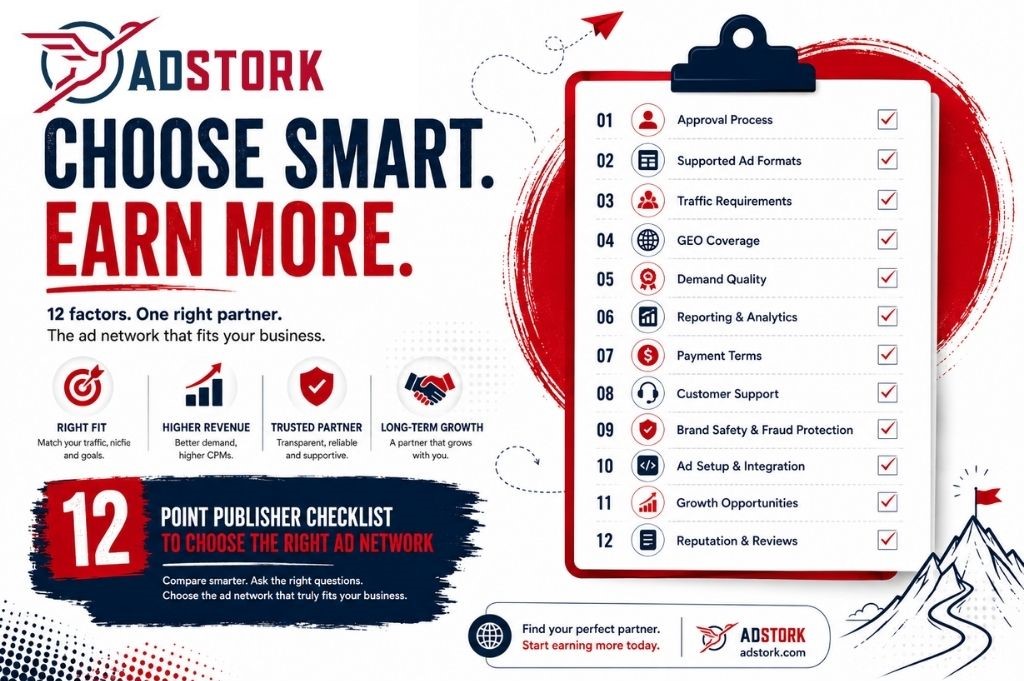
-
31 Aug, 2026
How to Choose an Ad Network for Your Website: A Publisher's Checklist
You have built a website. You are getting traffic. Now you need an ad network to monetize it.But with dozens of networks promising the highest CPMs and the best fill rates, how do you actually choose?Most publishers make this decision based on a single factor—usually a headline CPM number they saw on a competitor's site. That is a mistake. The network that pays the highest CPM for one publisher might be a poor fit for another. Your traffic, niche, geography, and goals all matter.This checklist walks you through 12 factors to evaluate before choosing an ad network. Use it to compare your options, ask the right questions, and find the partner that actually fits your business.Key TakeawaysChoosing an ad network based on CPM alone is a mistake—12 factors determine the right fit.Approval speed, traffic requirements, GEO coverage, and demand quality vary dramatically across networks.Your traffic volume, geographic mix, content niche, and growth goals should guide your choice.Reporting transparency, payment terms, support quality, and account management matter as much as CPM.Use this checklist to compare networks objectively and find the best partner for your site.The 12-Point Publisher ChecklistBefore signing up with any ad network, evaluate each of these 12 factors. They will determine your revenue, your experience, and your long-term success.1. Approval ProcessHow quickly and easily can you get started? Some networks approve publishers instantly, while others take days or weeks. Some have strict traffic requirements, while others work with sites of all sizes.• Is approval instant or does it require manual review?• What are the minimum traffic requirements?• Are there content restrictions or niche requirements?• What is the typical approval time?Fast approval matters because every day you wait is a day you are not earning. If you are a new or growing publisher, look for networks that approve sites of all sizes—not just established players with millions of visitors.Adstork: Instant approval. No minimum traffic requirements. Works with publishers of all sizes, from new bloggers to established sites. Get started the same day.2. Supported Ad FormatsDifferent networks support different ad formats. The right mix depends on your site type, audience, and content.• Does the network offer display banners, native ads, video, popunders, and interstitials?• Are there format restrictions based on traffic quality?• Can you mix and match formats?• Are there premium formats like rewarded video or in-page push?A network with a narrow format selection may limit your revenue potential. Look for networks that offer multiple formats so you can test and find what works best for your audience.Adstork: Multiple formats including display, native, video, popunder, and interstitial. Publishers can choose the formats that fit their site and audience.3. Traffic RequirementsSome networks have minimum traffic thresholds. Others work with publishers of all sizes.• What is the minimum monthly traffic requirement?• Are there quality requirements beyond volume?• Does the network evaluate traffic quality, not just quantity?• Will your site be accepted if you are in a growth phase?Traffic quality matters more than volume. A network that evaluates quality, not just quantity, is more likely to understand your site's value.Adstork: No minimum traffic requirements. We evaluate traffic quality, not just volume. Small publishers are welcome, and we help you grow.4. GEO CoverageWhere does the network have strong demand? If your traffic is primarily from tier-2 or tier-3 countries, you need a network with demand in those regions.• Which countries does the network cover well?• Are there regional gaps in fill rate or CPM?• Does the network specialise in certain geographies?• Will your specific geos be well-monetized?A network with strong US demand but weak European demand may not be the right fit if your audience is in Europe. Check coverage for your specific geos.Adstork: Global demand coverage with strong presence across tier-1, tier-2, and tier-3 markets. Multiple demand sources ensure better fill in more regions.5. Demand QualityNot all demand is created equal. Premium demand sources pay higher CPMs and provide better fill rates. Lower-quality demand can hurt your user experience and brand reputation.• What demand sources does the network connect to?• Are they premium SSPs and advertisers or lower-tier exchanges?• Does the network work with direct advertisers?• What is the advertiser quality and reputation?Premium demand sources translate to higher CPMs, better fill, and cleaner ad experiences. Ask which SSPs and advertisers are behind the inventory.Adstork: Multiple premium demand sources including leading SSPs and direct advertisers. Header bidding technology ensures competition drives higher CPMs.6. Reporting and AnalyticsYou cannot optimise what you cannot measure. Transparent, granular reporting is essential for understanding your performance.• What metrics are available (fill rate, CPM, eCPM, revenue per session)?• Can you segment by country, device, format, and placement?• Are reports available in real time or daily?• Can you export data for custom analysis?Basic reporting shows impressions and earnings. Advanced reporting shows fill rate, CPM, eCPM, and revenue per session segmented by every dimension that matters.Adstork: Transparent, real-time reporting with granular segmentation by country, device, format, and placement. Exportable data for custom analysis.7. Payment MethodsHow and when will you get paid? Payment flexibility matters, especially for international publishers.• What payment methods are available (bank transfer, PayPal, wire, crypto)?• Are there fees associated with different payment methods?• What currencies are supported?• Is payment reliable and consistent?Look for networks that offer payment methods that work in your country. International publishers should check that bank transfers or other options are available.Adstork: Multiple payment options including bank transfer, PayPal, and wire. Regular, reliable payments with transparent terms.8. Minimum PayoutEvery network has a minimum payout threshold. If your earnings are low, you may wait months to receive payment.• What is the minimum payout threshold?• How often are payments processed?• Can the threshold be adjusted?• What happens if you do not reach the threshold?A low minimum payout is better for smaller publishers. A high threshold may mean waiting months for your first payment.Adstork: Competitive minimum payout with regular payment cycles. Designed to work for publishers of all sizes.9. Support QualityWhen something goes wrong, you need responsive, knowledgeable support. Good support can be the difference between a minor issue and a major revenue loss.• What support channels are available (email, chat, phone)?• What are the typical response times?• Is support available in your time zone?• Do they offer optimisation advice or only technical support?Look for networks with responsive support that provides actual help, not just automated responses. Optimisation guidance is a bonus that shows the network is invested in your success.Adstork: Dedicated publisher support with quick response times. Optimisation guidance and technical assistance included.10. Integration EaseHow difficult is it to integrate the network's ads on your site? Simple integration means less technical work and faster time to revenue.• What is the integration process like?• Are code snippets provided?• Is there support for WordPress, Shopify, or other platforms?• Do you need developer assistance?Look for networks with simple, well-documented integration. If you are not a developer, pre-built plugins or clear instructions are essential.Adstork: Simple integration with clear code snippets and documentation. Works with all major platforms including WordPress.11. Ad Quality and User ExperienceThe ads served on your site affect your brand reputation and user experience. Low-quality ads can drive visitors away and damage your long-term value.• What is the quality of creative and advertiser content?• Are there controls to block low-quality or inappropriate ads?• Does the network enforce creative standards?• Can you blacklist certain advertisers or categories?Ad quality directly affects user retention. Networks with strong creative standards and brand safety controls protect your site's reputation.Adstork: Ad quality controls including blocklists and category restrictions. Focus on maintaining positive user experience.12. Account ManagementDo you get a dedicated account manager who understands your business, or are you just another number in the system?• Do you get a dedicated account manager?• What is their expertise and availability?• Do they provide optimisation recommendations?• Are they invested in your long-term success?A dedicated account manager who knows your site and provides proactive optimisation advice can significantly increase your revenue over time.Adstork: Dedicated account management with optimisation guidance and proactive support. We are invested in your success.Finding the right ad network means evaluating all 12 factors. Adstork was designed with publishers in mind—instant approval, multiple formats, global demand, transparent reporting, and dedicated support. Compare Adstork against other networks and see how we stack up on every factor in this checklist.Industry Insight: What Publishers Actually WantIn the AdMonsters 2026 Publisher Survey, publishers ranked their top priorities when choosing an ad network:1. Transparent reporting (91%)2. Fill rate and demand quality (87%)3. Payment reliability and terms (83%)4. Support responsiveness (79%)5. Integration ease (76%)Notice that CPM did not top the list. Publishers want transparency, reliability, and support—not just the highest headline number. The networks that deliver on these priorities earn long-term publisher loyalty.The survey also found that publishers who switch networks most often cite reporting transparency and support quality as the primary reasons. The network that provides the clearest data and best support retains publishers longer.Comparison Table: Adstork vs. Common Network TypesHow Adstork compares to typical network profiles across the 12 factors.FactorAdstorkPremium SSPLarge Ad NetworkNiche NetworkApproval SpeedInstantDays to weeksDaysDaysTraffic RequirementsNoneHigh (500K+ visits)ModerateVariesFormatsMultipleLimited (premium)MultipleLimitedGEO CoverageGlobalTier-1 focusedGlobalRegionalDemand QualityPremiumPremiumMixedVariesReportingTransparent, granularPremiumBasicVariesPayment FlexibilityMultiple optionsLimitedMultipleVariesMinimum PayoutCompetitiveHighModerateVariesSupportDedicatedPremiumBasicVariesAccount ManagementDedicatedPremiumLimitedVariesFuture Outlook: How to Choose Networks in 2026 and BeyondThe ad network landscape is evolving. Several trends are reshaping how publishers should choose partners.First-party data integration is becoming essential. Networks that help publishers collect and activate first-party data will be more valuable in the post-cookie era.Transparency requirements are increasing. Publishers are demanding more visibility into demand sources, fees, and auction dynamics.Multiple format support is becoming standard. Publishers want one partner that can handle display, native, video, and popunders.AI-powered optimisation is becoming available. Networks that provide automated optimisation recommendations will help publishers maximise revenue.When choosing a network in 2026, look for partners that are investing in these capabilities. The network that helps you prepare for the future will be a better long-term partner.Choosing the right ad network is one of the most important decisions you will make as a publisher. The wrong network can mean lower revenue, poor support, and a frustrating experience. The right network can be a true partner in your growth.Use this 12-point checklist to evaluate your options objectively. Compare approval speed, formats, demand quality, reporting, payment terms, support, and every other factor that matters. Do not settle for a network that only delivers on one dimension.Adstork was built to meet every point on this checklist—instant approval, global demand, transparent reporting, dedicated support, and multiple formats. Sign up for a free Adstork publisher account and see how we compare to your current or potential networks.Your immediate action plan: Evaluate your current ad network against this checklist. Identify gaps. Research 2-3 alternatives and compare them on all 12 factors. Choose the network that best fits your traffic, niche, and growth goals. Share your comparison with Adstork's team for a personalised recommendation.Frequently Asked QuestionsHow do I choose an ad network for my website? Evaluate networks based on 12 factors: approval process, supported formats, traffic requirements, GEO coverage, demand quality, reporting, payment methods, minimum payout, support quality, integration ease, ad quality, and account management. The right network depends on your traffic, niche, geography, and growth goals.What is the most important factor when choosing an ad network? Reporting transparency is the top priority for most publishers, followed by fill rate/demand quality and payment reliability. However, the most important factor depends on your specific situation—a new publisher may prioritise approval speed, while an established site may prioritise premium demand.Can I use multiple ad networks at the same time? Yes. Many publishers use multiple networks to maximise fill rates and competition. Header bidding allows multiple networks to bid on the same inventory simultaneously, driving higher CPMs. However, managing multiple networks requires more technical effort and reporting complexity.How long does ad network approval typically take? Approval times vary widely. Some networks offer instant approval, while others take days or weeks. Adstork offers instant approval, so you can start earning the same day.Do I need a dedicated account manager? A dedicated account manager can significantly improve your revenue by providing proactive optimisation advice and quick support. Publishers with dedicated managers typically earn more than those in self-service setups.What should I look for in ad network reporting? Look for transparent, granular reporting that shows fill rate, CPM, eCPM, and revenue per session segmented by country, device, format, and placement. Real-time or daily reports are better than monthly summaries.
Read More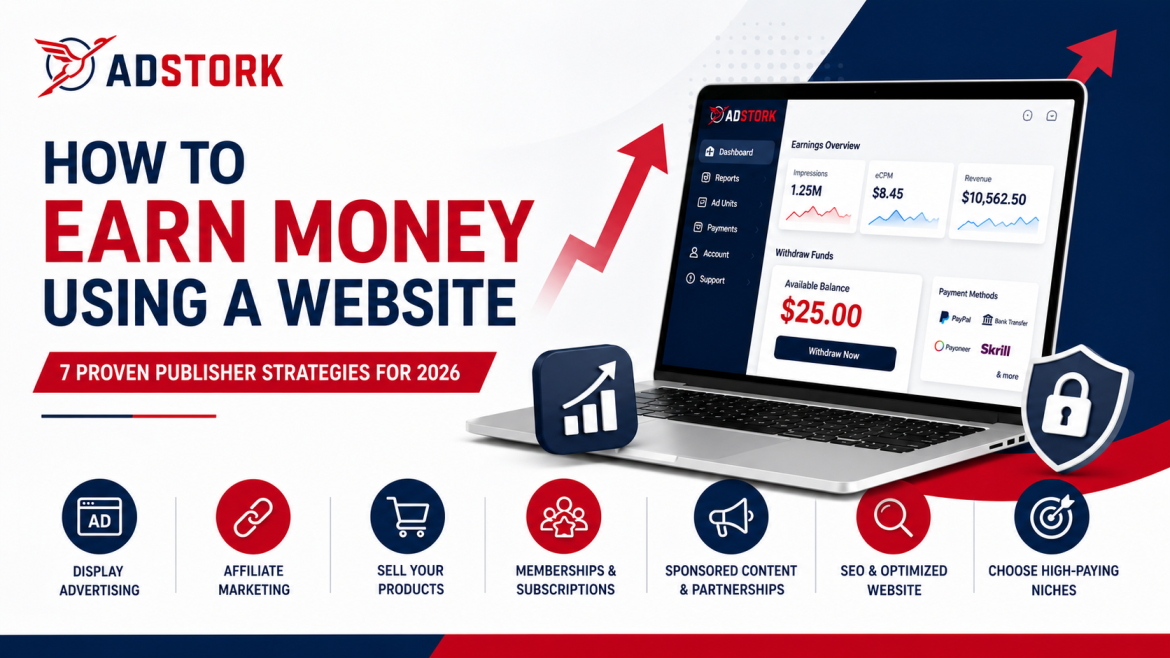
-
27 Aug, 2026
How to Earn Money Using a Website: 7 Proven Publisher Strategies for 2026
Your website is not just an online space for people to visit. It is a real income source, if you know the right strategies.Whether you are a new blogger testing the waters or an established publisher with consistent traffic, there are multiple ways to turn your audience into revenue. The most successful website owners do not rely on a single income stream. They combine display ads, affiliate marketing, digital products, and strategic partnerships to build a diversified revenue engine.This guide walks you through seven proven strategies to earn money using your website and how to maximise each one in 2026.Key TakeawaysDisplay advertising is the fastest way to start earning, join ad networks like Adstork for instant approval and passive revenue.Affiliate marketing earns commissions by recommending products your audience genuinely wants.Selling your own products (digital or physical) keeps 100% of the profit with no middleman.Paid memberships and subscriptions turn loyal readers into recurring revenue.Sponsored content pays well when you have an engaged audience brands want to reach.High-paying niches like tech, finance, and health command better CPMs and affiliate deals.The most successful publishers combine multiple income streams for sustainable growth.1. Display Advertising: The Fastest Way to Start EarningDisplay advertising is the most accessible way to monetize your website. By joining an ad network, you connect your inventory with advertisers who want to reach your audience. You earn revenue every time a visitor sees or clicks on an ad.The beauty of display ads is their scalability. The more visitors you have, the more ad revenue you earn. It is passive income that grows with your traffic, no extra work required beyond your content creation.Adstork makes this simple. Unlike many networks that take days to approve publishers, Adstork approves sites instantly. You can display ads the same day and start earning right away. No complicated forms. No endless paperwork.Neuromarketing insight: display ads work best when they feel natural and unobtrusive. Users have developed banner blindness for aggressive, intrusive formats. Choosing a network that offers diverse formats:- native, display, video, and popunder gives you the flexibility to find what works best for your audience.2. Affiliate Marketing: Earn Commissions by Recommending ProductsAffiliate marketing is one of the most effective ways to earn online without creating your own products. You promote other companies' products or services through special tracking links. When someone clicks your link and makes a purchase, you earn a commission.Success in affiliate marketing depends on trust. Your readers trust your recommendations. Promoting products you genuinely believe in and that your audience actually wants ensures higher conversion rates. Trust equals clicks, and clicks equal sales.Popular affiliate programs include Amazon Associates, ShareASale, Rakuten, and niche-specific networks. Choose programs that align with your content and audience interests.3. Sell Your Own Digital or Physical ProductsIf you have something valuable to offer, selling your own products captures 100% of the profit. No middleman. No commission sharing.Digital products are especially attractive for website owners. Ebooks, online courses, templates, presets, software, and design assets have no physical inventory or shipping costs. You create them once and sell them indefinitely.Physical products like merchandise, branded items, or custom goods work well if you have a dedicated following. Platforms like Shopify or WooCommerce make it easy to set up an online store directly on your website.4. Paid Memberships and SubscriptionsTurn your loyal readers into paying subscribers by offering premium content. This model provides predictable, recurring revenue and deepens your relationship with your most engaged audience members.Premium content might include exclusive articles, video content, behind-the-scenes access, community forums, or early access to new content. Tools like Patreon, Substack, and MemberPress make it easy to manage subscribers and recurring payments.Subscriptions work best when you have established trust and authority in your niche. Readers pay for access to expertise, community, or content they cannot find elsewhere.5. Sponsored Content and Brand PartnershipsAs your audience grows, brands will pay for access to your readers through sponsored content. This includes paid reviews, sponsored blog posts, product features, and social media promotion.The key to successful sponsored content is authenticity. Readers value transparency and honesty. Always disclose sponsored relationships clearly and only accept partnerships that genuinely serve your audience. Trust is your most valuable asset.The more engaged your audience, the more brands will pay for placement on your site. Building a loyal, high-quality readership is the foundation of profitable sponsored content partnerships.6. Build an SEO-Optimized, Ad-Friendly WebsiteYour website's technical foundation affects both search engine visibility and ad performance. An ad-friendly, SEO-optimized site attracts more traffic and commands higher CPMs.Use responsive design that works flawlessly on mobile and desktop. Google's mobile-first indexing means mobile performance directly affects your search rankings. Keep your site fast, clean, and easy to navigate.Tools like WordPress, React, or other modern frameworks provide strong SEO foundations. Optimise page speed, use clear HTML, and consider header bidding solutions like Prebid.js to connect with multiple DSPs and SSPs for better ad revenue.7. Choose High-Paying Niches for Better EarningsNot all topics pay the same. Some niches attract significantly higher ad budgets and affiliate commissions than others. Focusing on industries with strong advertiser demand can dramatically increase your earnings.High-paying niches include:• Finance and investing—advertisers pay premium CPMs for audiences with purchasing power.• Tech and electronics—high product prices mean strong affiliate commissions.• Health and wellness—consistent advertiser demand and premium CPMs.• Retail and shopping—strong purchase intent and high conversion rates.• Beauty and fashion—visual content drives product recommendations and affiliate sales.• Gaming and entertainment—engaged audiences with spending potential.Writing about these niches can help you earn higher CPMs and better affiliate deals. Even if your site is not in a premium niche, you can still succeed—you may just need more traffic to achieve the same revenue.Display advertising is the foundation of website monetization, and Adstork makes it simple to get started. With instant approval, multiple ad formats, and transparent reporting, you can start earning from your traffic the same day you sign up. Join Adstork as a publisher and see how fast approval changes your revenue timeline.Industry Insight: The Multi-Stream AdvantageThe most successful website owners do not rely on a single income stream. They build diversified revenue models that combine multiple strategies.Display ads provide passive, scalable revenue that grows with your traffic. Affiliate marketing captures value from product recommendations. Digital products capture 100% profit from your expertise. Memberships provide predictable, recurring income. Sponsored content monetises your influence and audience trust.Diversification protects you from any single source of revenue declining. If ad CPMs drop, affiliate commissions or product sales can compensate. If one affiliate program changes its terms, others remain.Start with display advertising for instant, passive revenue. Then layer additional strategies as your traffic and authority grow. Each new stream builds on the last.Comparison Table: 7 Website Monetization StrategiesA quick reference guide to the seven strategies, their pros, cons, and best use cases.StrategyProsConsBest ForDisplay AdsPassive, scalable, instant approvalRequires traffic, CPM variesAll publishers, especially beginnersAffiliate MarketingNo inventory, high potentialRequires trust, commission-basedContent sites with loyal audiencesSelling Products100% profit, full controlRequires creation, fulfillmentEstablished brands with expertiseMembershipsRecurring revenue, loyal audienceRequires exclusive contentSites with strong communitySponsored ContentPremium rates, brand relationshipsRequires audience, relationship buildingSites with engaged, niche audiencesSEO OptimizationFree traffic, sustainable growthTakes time, ongoing effortAll content-focused publishersHigh-Paying NichesPremium CPMs, better dealsMore competition, specialized contentSites targeting finance, tech, healthFuture Outlook: Website Monetization in 2026 and BeyondThe landscape of website monetization is evolving rapidly. Several trends are shaping how publishers earn money in 2026.First-party data is becoming essential. As third-party cookies disappear, publishers who collect and activate first-party audience data will command premium CPMs. Start building email lists and audience relationships now.AI-powered optimization is making it easier to maximise revenue. Machine learning models can optimise ad placement, floor prices, and demand routing in real time.Diversification is becoming more important. Relying on a single income stream is increasingly risky. The most successful publishers will combine display ads, affiliate marketing, products, and memberships.User experience is becoming a competitive advantage. Publishers who prioritise clean, fast, ad-friendly sites will outperform those who sacrifice experience for short-term revenue.The future belongs to publishers who build genuine audience relationships, diversify their revenue streams, and embrace new technologies to optimise their earnings.Your website is more than a digital space. It is a revenue engine waiting to be activated. With the right strategies—display ads, affiliate marketing, digital products, memberships, and sponsored content—you can turn your traffic into sustainable income.Start with display advertising for instant, passive revenue. Then layer additional strategies as your traffic and authority grow. The most successful publishers combine multiple income streams and optimise each one for maximum yield.Adstork makes it simple to start earning from day one. With instant approval, multiple ad formats, and transparent reporting, you can begin monetizing your traffic immediately. Join Adstork as a publisher today and turn your website into a money-making machine.FAQsHow much traffic do I need to start earning from display ads? You can start earning with as little as 1,000 monthly visitors. However, earnings scale with traffic volume. Adstork approves publishers of all sizes, from new bloggers to established sites.What is the fastest way to start earning from my website? Display advertising is the fastest way to start earning. Join an ad network like Adstork with instant approval, place ad units on your site, and start earning the same day.Can I combine multiple monetization strategies? Yes. In fact, the most successful publishers combine multiple strategies. Display ads provide passive revenue, affiliate marketing earns commissions, digital products capture 100% profit, and memberships provide recurring income.What are the highest-paying niches for publishers? Finance, tech, health, retail, beauty, fashion, and gaming tend to have the highest CPMs and best affiliate opportunities. These industries attract strong advertiser budgets and premium rates.How does Adstork differ from other ad networks? Adstork offers instant approval so you can start earning the same day. The platform connects you to multiple premium demand sources, provides transparent reporting, and supports multiple ad formats. Publishers at all levels can monetize their traffic effectively.Do I need a large audience to earn from sponsored content? Not necessarily. Brands value engagement and trust over raw traffic numbers. A smaller but highly engaged audience in a niche topic can command premium rates from relevant brands.
Read More